Your recipes, rewritten for the way you actually cook.
I turned a recurring personal pain point into a release-ready iOS product—owning the product decisions, orchestrating AI collaborators, and taking it from structured handoff to a public App Store launch in an 18-day build cycle.
My role
Independent Product Manager / AI Product Builder · end-to-end owner
Current status
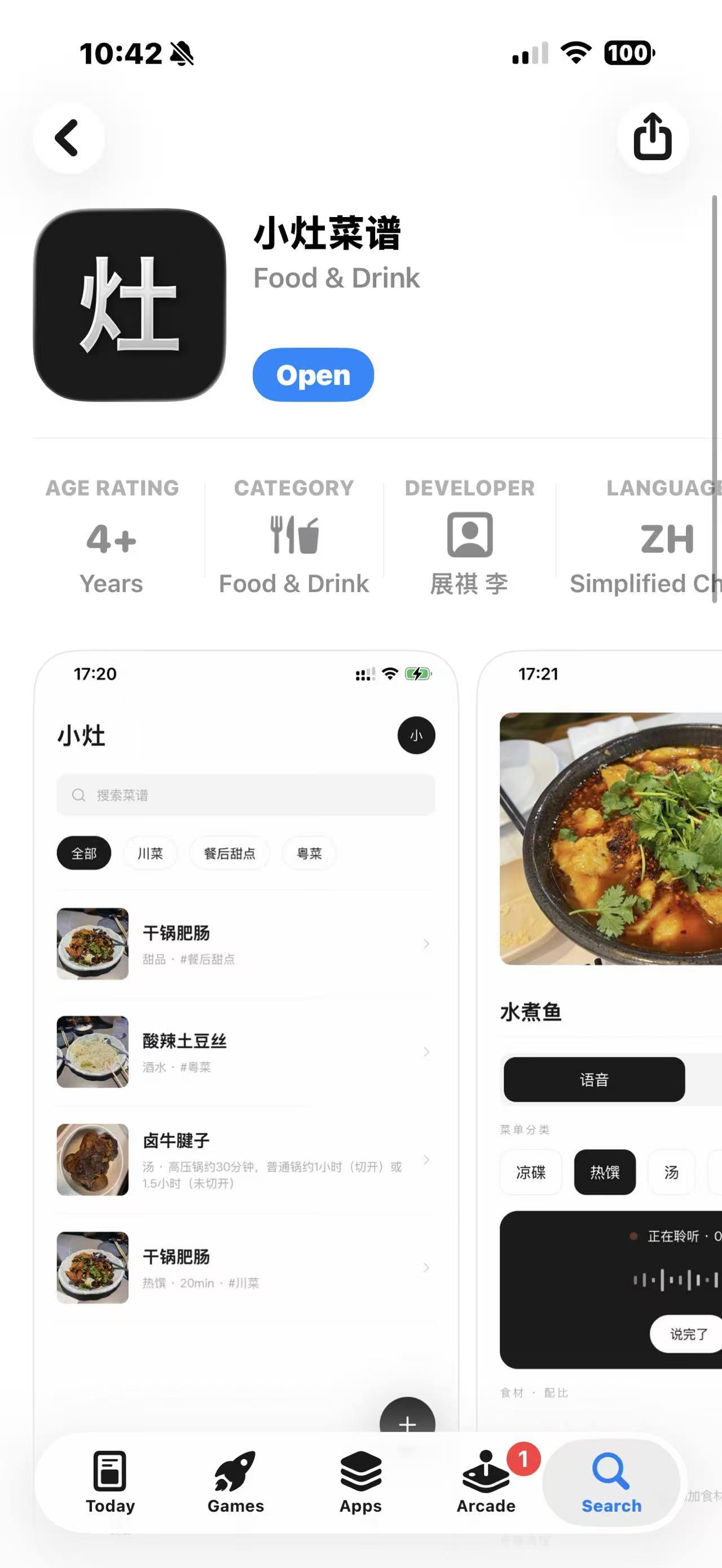
Live on the App Store · v1.0.0
Product
Xiaozao 小灶 · iOS
Timeline
Jun 22 – Jul 10, 2026 · 18 days
Public release
Live · Jul 2026
Availability
Global, excl. mainland China
Interface
Simplified Chinese
Product stack
React Native · Supabase · DeepSeek
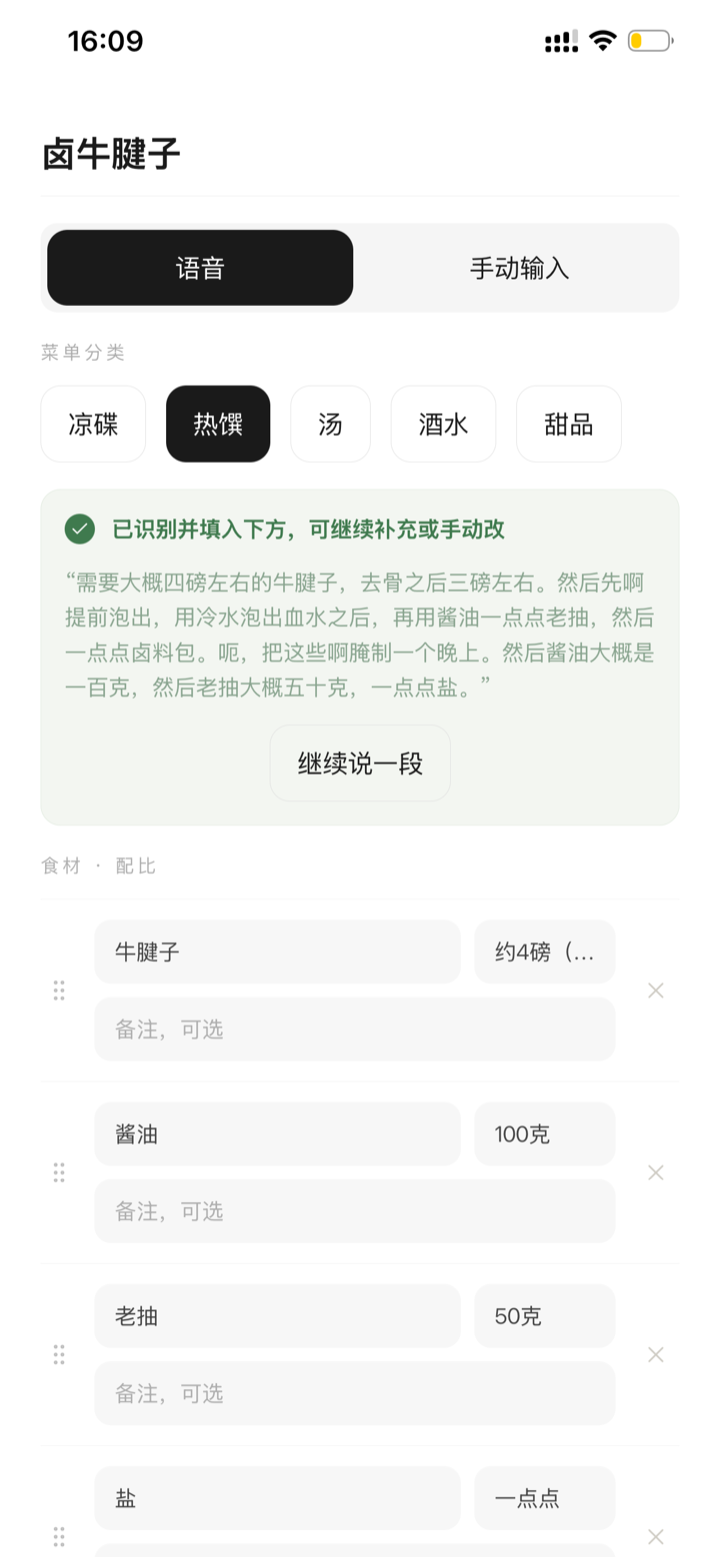
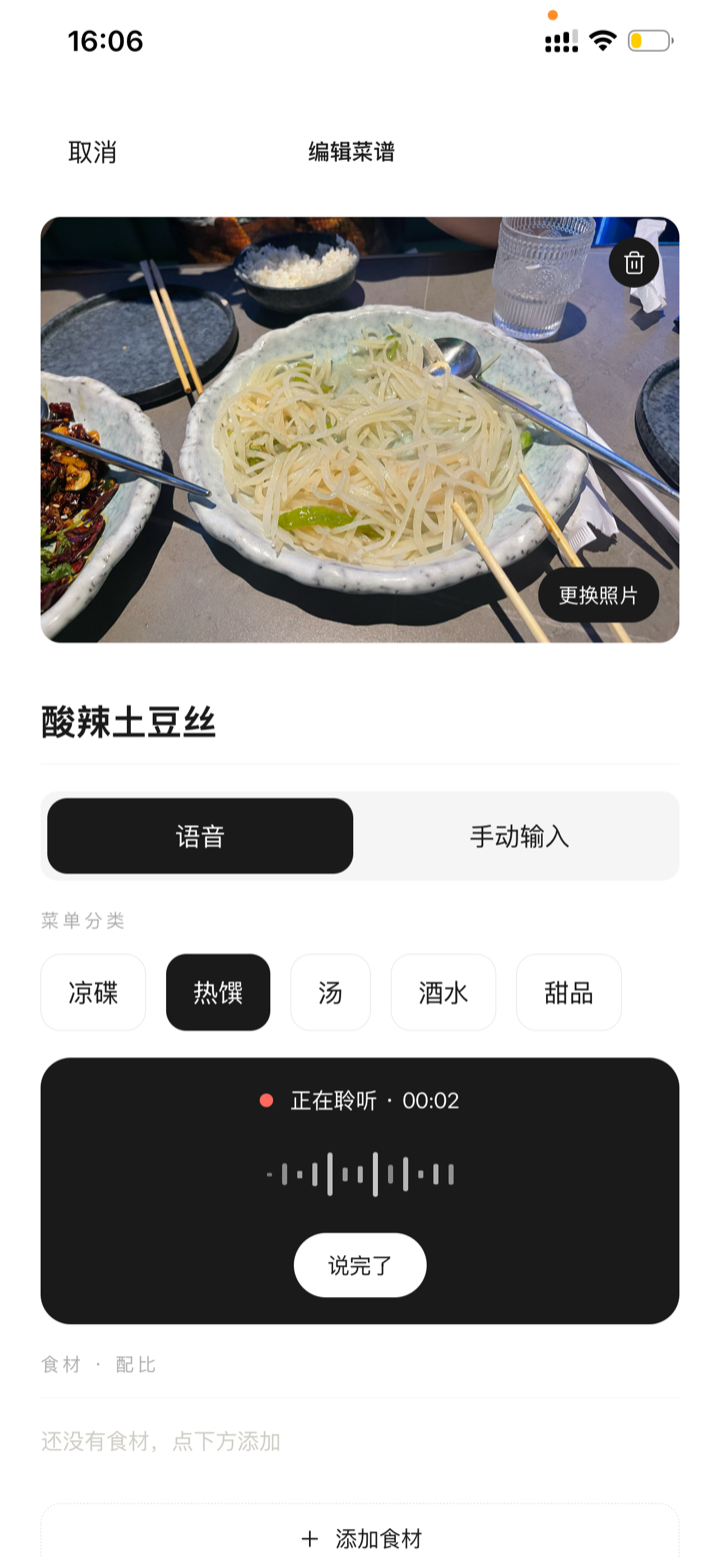
Live on the App Store, and a voice capture already structured into an editable draft.
01Background
The recipe existed. My version of it did not.
I enjoy cooking from videos and social posts, but the useful recipe is rarely the original one. It is the version adjusted to my cookware, available ingredients, and my family’s taste—and those changes were the easiest part to lose.
Video tutorial
Saved post
Illustrative recreation—recipes stay on the platforms where they were found. No real accounts or creators shown.
1
The recipe stays where I found it
Retrieval starts with reopening social media.
Cooking references remain scattered across YouTube, Xiaohongshu, and saved posts. Finding the same recipe again means remembering the platform, creator, or search phrase.
what actually worked
less sugar
air fryer instead of oven
double the sauce
Illustrative artifact—the kind of adjustments that kept getting lost. Not a product screenshot.
2
My adaptations disappear
The changes that made the dish work are not captured.
I substitute ingredients, change quantities, or adjust the method for my kitchen and family. The next time I cook, those decisions are often reconstructed from memory.
Manual entry, field by field
+ add another field
Illustrative abstraction of form-heavy recipe entry. Category-level; no specific product depicted.
3
Existing tools introduce new friction
Manual recipe entry feels like administrative work.
The products I explored either carried more complexity than this task needed or relied on dated, form-heavy input. The opportunity was not a larger recipe platform; it was a faster way to preserve one’s own cooking memory.
02Core journey
One focused journey, from memory to a reusable recipe.
Xiaozao does not ask AI to publish a recipe on the user’s behalf. It turns natural speech into a structured draft, then keeps the user in control of the final record.
Step 1 · Account
Sign in once. Keep a cloud-backed recipe library.
Users sign in with email OTP or Sign in with Apple. Recipes, tags, menus, profile data, and photos live in authenticated Supabase-backed storage—account-backed data keeps the recipe library available beyond one local installation.
Onboarding: capture by voiceOnboarding: keep your notesOnboarding: set a menuEmail OTP + Sign in with Apple
Step 2 · Capture
Speak naturally. Review a structured draft.
The user records in natural Chinese. Bailian qwen3-asr-flash transcribes the audio, DeepSeek converts the transcript into structured recipe fields, and the app returns an editable draft—with the original transcript kept in view.
AI accelerates capture; the user remains the editor.
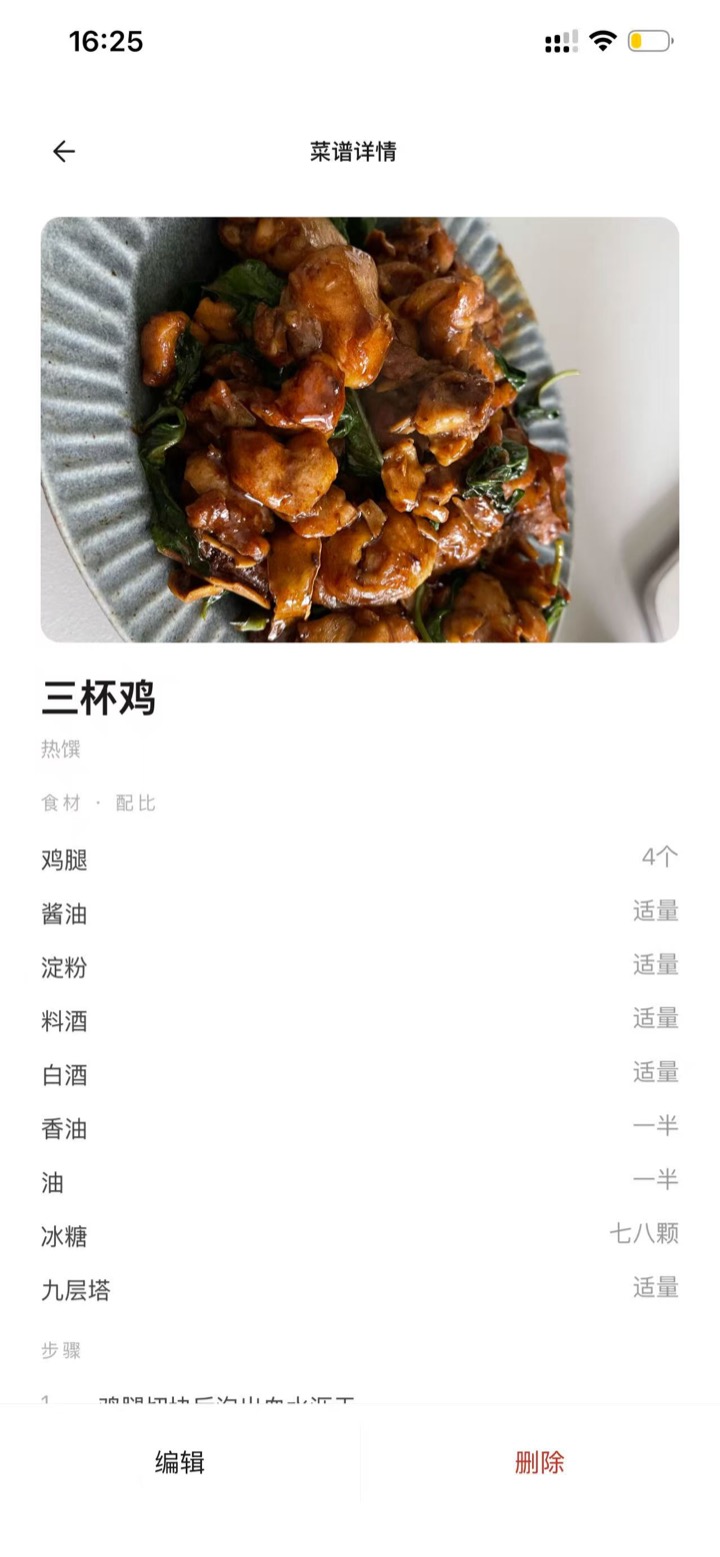
Recipes are retrieved with their photos, ingredients, and steps. Users collect dishes into a menu, then generate a 3:4 menu image saved straight to Photos. An in-app system share flow was deliberately removed—saving the image was the whole job.
Recipe detailCompose a menu3:4 menu image, saved to Photos
03How I worked with AI
I did not use one model as an autopilot. I designed a delivery system.
Different stages benefited from different strengths, but model variety only worked because tasks were bounded, decisions were recorded, and every handoff was treated as a claim to verify—not as truth.
Orchestrating specialized collaborators
Codex and Claude Code acted as the command brain: they turned owner decisions into bounded plans, delegated execution through zcode—which calls models such as GLM, Kimi, and DeepSeek—then audited every returned handoff against the repository, so execution stayed aligned with intent. Canonical project documents kept each collaborator loading only the minimum necessary context—there is no measured token figure, and this page does not invent one.
Planning & audit agent — Claude Design · Codex · Claude Code: specs, bounded plans, handoff audits
Execution agent — GLM · Kimi · DeepSeek, called through zcode; every handoff returns for audit
Runtime LLM — Bailian qwen3-asr-flash (ASR) · DeepSeek (LLM) inside the shipped product—a separate role from DeepSeek’s build-time execution
Human owner — decisions, credentials, consoles, real-device QA, release accountability
1
Design handoff
Claude Design maintained the design system, specs, and implementation backfills
Defined the user problem, product scope, and acceptance bar
2
Architecture & roadmap
Codex and Claude Code contributed ADRs, technical plans, and bounded task definitions
Approved architecture, provider, security, and scope decisions
3
Implementation
Turned decisions into bounded plans; audited every returned handoff
Executed bounded implementation tasks via zcode and handed the diff back
Prioritized tasks, resolved trade-offs, accepted or rejected changes
4
Cloud & runtime-AI setup
Produced runbooks and diagnostics for provider and Supabase operations
Executed bounded configuration and integration tasks under the same handoff rules
Bailian ASR and DeepSeek LLM wired in as the product’s runtime AI
Held every credential; performed registrations, migrations, deploys, and console operations
5
QA & review
Ran type checks, export checks, audits, and documentation-consistency reviews
Fixed bounded QA findings; fixes returned for audit
Performed simulator and real-device flows; decided whether evidence closed each gate
6
Apple release
Release documentation, issue diagnosis, and submission checklists
Executed bounded release-hardening tasks
Apple membership, certificates, App Store Connect, archive, submission—final accountability
The reliability triangle: reducing hallucination
Continuity came from three controls working together—each one turns an AI claim into something that can be checked.
Project memory
Handoff context
Audit + review
Alignment: intended goal · actual code · claimed status